The essentials
- Orcas and humpbacks follow herring into the Tromsø and Skjervøy fjords roughly every November through January.[1]
- Since around 2017, whales near Tromsø have usually gathered in the Kvænangen fjords near Skjervøy rather than the waters closer to Tromsø.[1]
- From Tromsø: Whale Watching Safari on High-Speed Catamaran, from US$220, 8 hours, rated 4.61 from 3,768 reviews.[2]
- Tromsø whale watching guidelines say to approach whales slowly, at less than 5 knots when within 300m.[3]
- The average winter temperature in Tromsø is around −4°C, and RIB operators provide full-length flotation suits to wear over your clothes.[4][5]
- Top choice Whale Safari Catamaran from US$220 Duration8 hours[2]Rating4.61 from 3,768 reviews[2]GuideLive tour guide: English[2]CancellingFree up to 24 hours before[2] Check availability
- RIB Safari at Skjervøy from US$251 Duration3 - 12 hours[6]Rating4.78 from 136 reviews[6]GuideLive tour guide: English[6]CancellingFree up to 24 hours before[6] See this tour
- Fast Catamaran Tour from US$210 Duration7.5 hours[7]Rating4.71 from 661 reviews[7]GuideLive tour guide: English[7]CancellingFree up to 24 hours before[7] See this tour
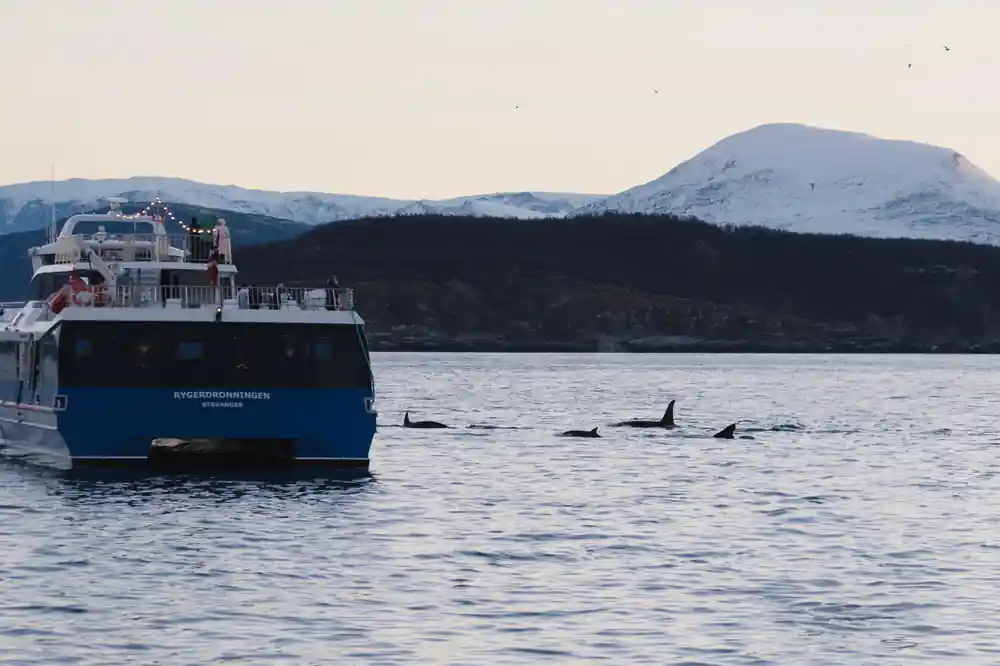
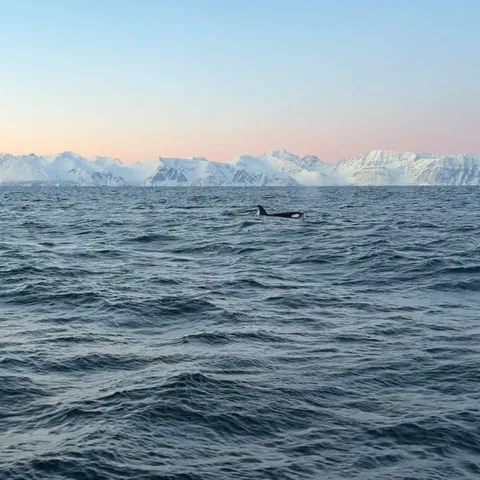
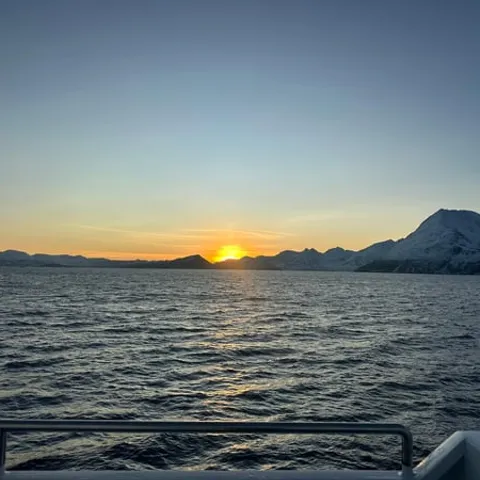
Unlike traditional vessels, our boats are designed for Arctic whale watching, operating silently in electric mode to ensure minimal disturbance to the ocean and its inhabitants.
Is the catamaran safari worth booking?
Booking tips
- Target the November to January window, when orcas and humpbacks follow the herring into the fjords.[1]
- The 8-hour catamaran safari from Tromsø is from US$220 per person.[2]
- Free cancellation up to 24 hours in advance for a full refund on this listing.[2]
- The high-speed catamaran safari is wheelchair accessible.[2]
On the day
- Expect blue twilight rather than bright daylight once the polar night sets in.
- Winter in Tromsø averages around −4°C, so pack warm layers and a windproof outer shell.[4]
- Guidelines ask boats to approach slowly, at less than 5 knots when within 300m of whales.[3]
- Starting times vary by date, so check availability for your date when you book.[2]
From Hunting Ground to Wildlife Sanctuary
For most of the time people have lived on this coast, a whale was a harvest. It was oil for lamps, meat for winter, bone for tools, and the fjords around Tromsø were worked the way a field is worked. Skippers read the water and the birds, learned where the herring gathered, and followed the same animals that whale watchers now chase with cameras. Hunting crews knew the migration better than anyone, and some of that knowledge passed straight into the wildlife industry when the work changed. The water itself has not changed. What we do on it has.
That reversal is recent, and it was not tidy. It came out of long argument between coastal communities, scientists, politicians and fishing families, and many of the people who run whale safaris today grew up in families that hunted. In a small northern town you can meet both versions of the story in the same afternoon, over the same cup of coffee, which is part of what makes a trip here feel different from a visit to a wildlife park.
The watching side has its own manners. In Tromsø, whale watching guidelines say to approach whales slowly, at less than 5 knots when within 300m, at constant speed, from the side and slightly to the rear.[3] These are voluntary best-practice guidelines rather than direct government regulations, so the calmness of a trip depends a good deal on the crew and the operator.
The Herring Migrations That Moved the Whales
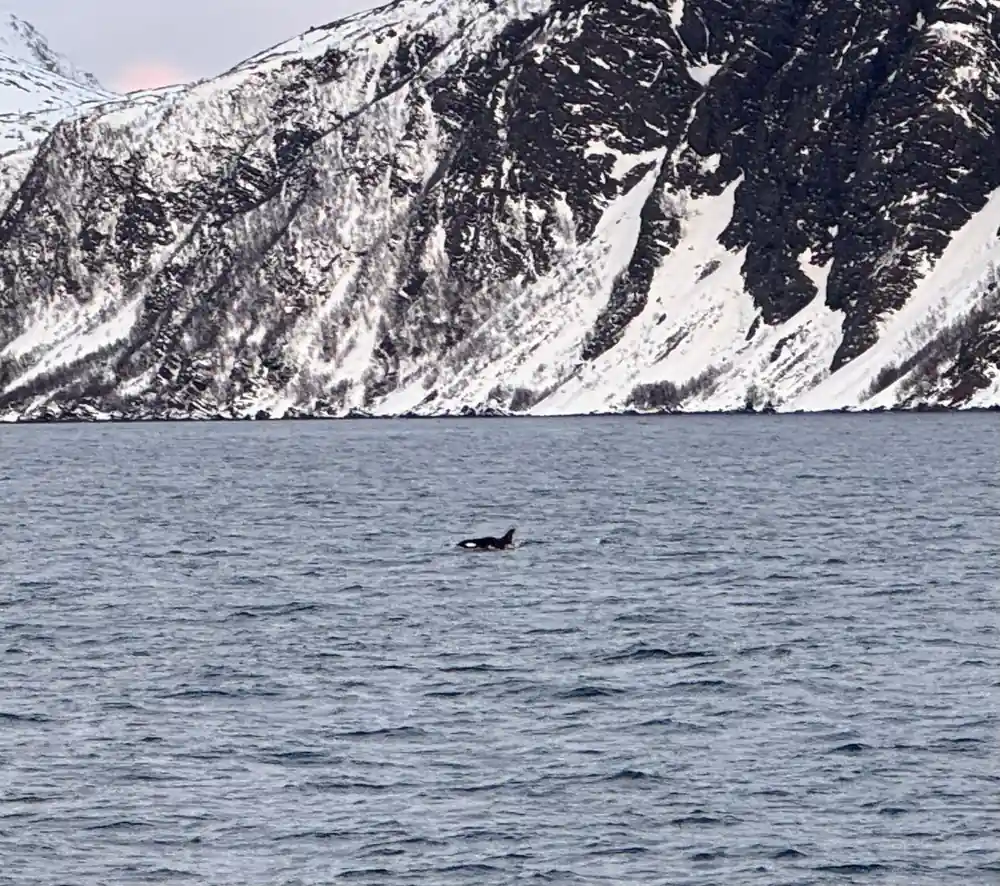
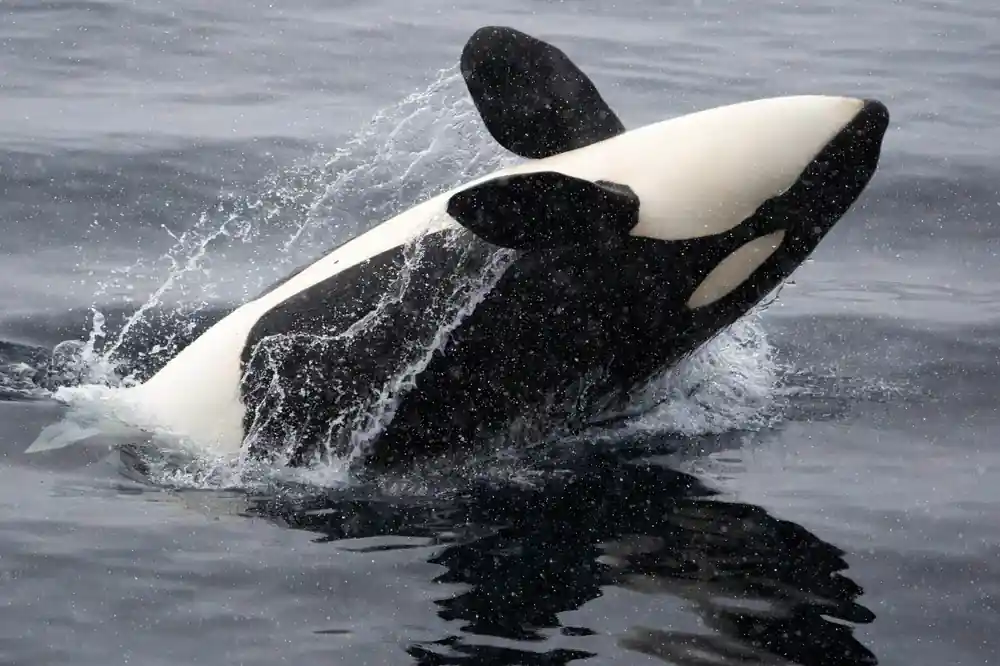
Everything that happens out there in winter starts with a small silver fish. The migration of Norwegian spring-spawning herring draws killer whales into northern Norwegian waters each winter.[8] Gulls and sea eagles gather over a shoal, and where the birds work, the water is usually alive. The orcas come for the herring, the humpbacks come for the same shoals, and the fjords the fish choose become, for a few weeks, one of the great wildlife gatherings in the north.
This is why the whale season is a season and not a year-round business. It runs roughly from November through January, when orcas and humpbacks follow herring into the Tromsø and Skjervøy fjords.[1] In summer the same water is beautiful and mostly empty of big whales, though minke whales and porpoises are occasionally spotted during summer, and sightings are fewer than in the winter season.[9]
The fish move, and the whales move with them, so the map is redrawn every year. Since around 2017, whales near Tromsø have usually gathered in the Kvænangen fjords near Skjervøy rather than the waters closer to Tromsø, and the same pattern held in the most recent season.[1] Many safaris run a long way north before anyone starts looking for a fin.
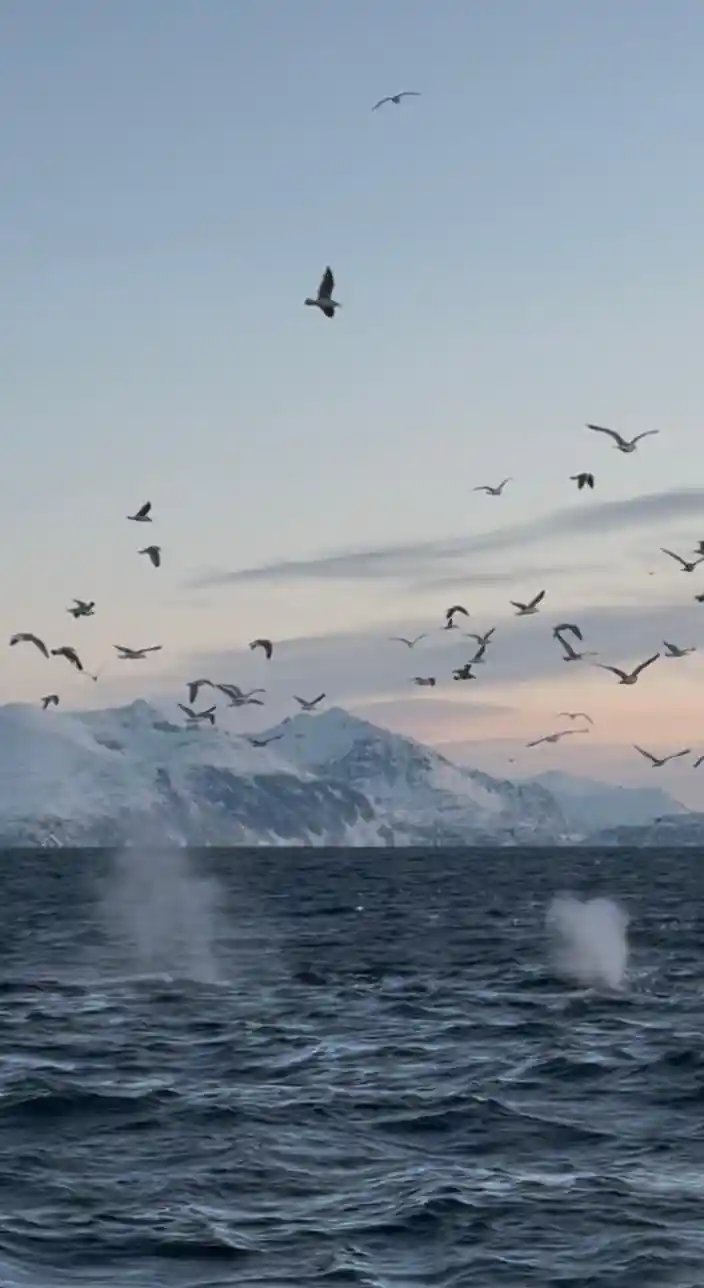
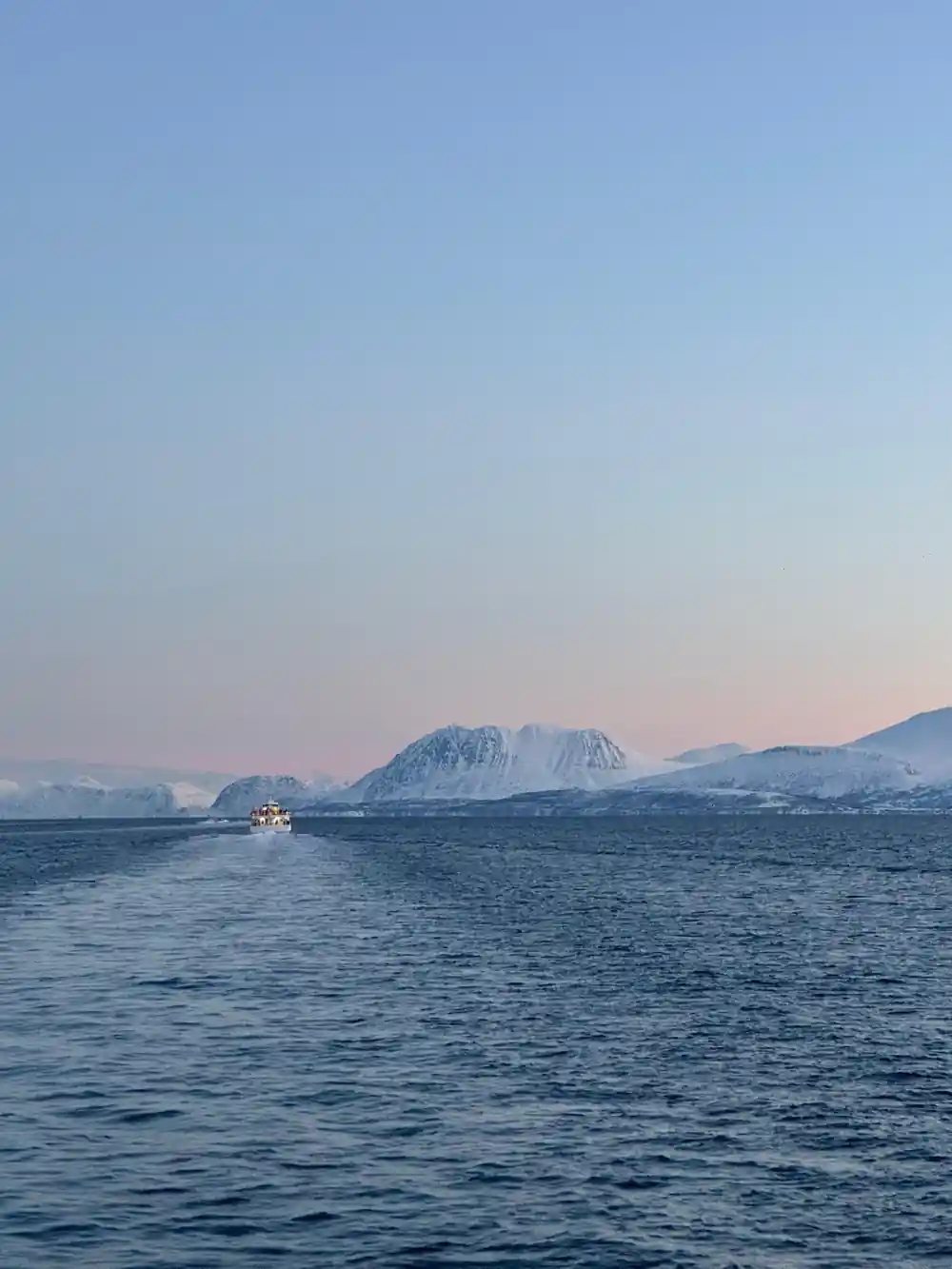
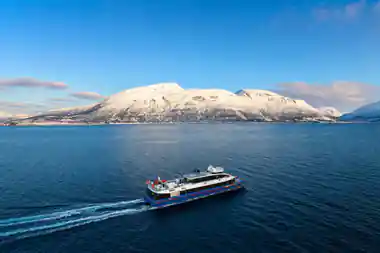
A catamaran waits below snow-covered peaks on the run north to Skjervøy.
Orcas and the Fishermen's Complex History
Ask a fisherman about orcas and you will usually get a complicated answer. For generations the two were rivals in the same water, chasing the same herring, and orcas earned a reputation as thieves that stripped fish from lines. That memory sits alongside a newer one, of the whale as a reason for visitors to come north in the darkest weeks of the year. The same boats that once chased the shoals now carry passengers who paid to watch the animals that used to steal the catch.
What has changed fastest is the technology of looking. Crews no longer rely on luck alone: to locate whales, Brim Explorer's crew watch for birds flying overhead where humpback whales push herring to the surface, and use modern technology such as radar and sonar to detect large obstacles in open water.[10] A flock of gulls working over flat water is still the oldest signal there is.
Sound matters as much as sight. In Tromsø, Brim Explorer runs a Silent Whale Watching tour on a hybrid-electric ship that operates silently in electric mode to minimize disturbance.[10] On a still winter morning a whale's blow carries a long way across the water, and a boat held at low power keeps that moment intact.
Whales in Coastal and Sámi Cultural Memory
Along this coast the whale was never only meat. It appears in stories told on the islands and in the fjord villages, in the way people talk about weather and luck, and in the older coastal Sámi world where the sea has its own rules and its own inhabitants. In those stories the whale is a powerful neighbour rather than property, and the sea is treated with a respect that sounds entirely practical to anyone who has spent a winter on it.
That memory is still visible on land. Harbour museums, boat sheds and family photographs in cafés record the hunting years without flinching and without nostalgia, alongside displays about the herring boom and the fishermen who followed it. Local guides are often the best source, and the stories they tell about their own grandparents land differently from anything behind glass.
For a visitor this is useful context rather than history for its own sake. It explains why a whale safari here feels like more than a boat trip: the animal at the centre of it has been argued over, worked, eaten and photographed by the same communities for a very long time. Museums in Tromsø and on the islands cover it well, and the coastal Sámi perspective is increasingly part of the story rather than a footnote.
from US$220
The high-speed catamaran safari to Skjervøy runs for 8 hours with a live English-speaking guide.[2]
Norway's Modern Whaling: Where It Stands Today
Norway still has a whaling industry, and minke whales are hunted in Norwegian waters, which keeps the country apart from most of its neighbours on this question. The industry that once filled the coast with try-works and whale oil is much smaller now, but it has not disappeared, and it is defended by people who see it as ordinary coastal work rather than a scandal.
For a traveller this creates an odd, honest situation. The same harbour that sends out wildlife boats can also be home to whaling crews, and one family may have a foot in both. Nobody hides it. If you want to understand the coast, read up before you arrive and ask careful questions once you are there; people here tend to answer directly and expect the same back.
What has clearly shifted is where the money and the attention go. Winter tourism now fills Tromsø's hotels in the months when the light is thinnest, and the whales are the draw. That has changed incentives along the coast far more effectively than any campaign, and it is the main reason the boats you see in the fjord are full of passengers rather than harpoons. Whether that settles the argument is another question, and nobody in the north pretends it is over.
What to Expect During Your Winter Safari
A whale day from Tromsø is a long day, and it usually begins before you want it to. On the high-speed catamaran safari the duration is 8 hours and the stops are listed as Catamaran, Skjervoy, Catamaran.[2] You travel, you watch, you travel home, often in fading blue light, and the middle part is why you came.
The light is part of the trip. In Tromsø, the Polar Night Season begins on November 27th and lasts until January 15th.[11] The average winter temperature in Tromsø is around −4°C, and it feels sharper on open water.[4] Indoors, catamarans and hybrid boats have saloons where you can warm your hands, charge a phone and eat whatever you brought.
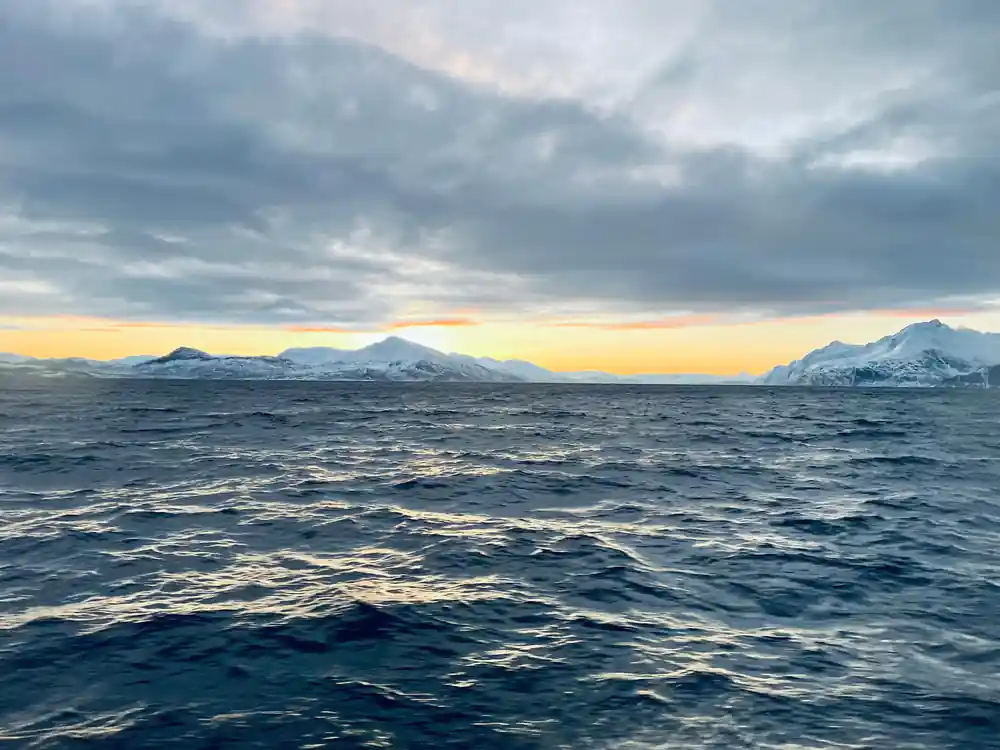
On deck, keep your expectations honest and your eyes on the water. Sightings are never guaranteed, and a day that finds nothing but birds, snow peaks and a flat grey sea is still a real Arctic day. When whales do appear, boats work under approach guidelines rather than at speed, so you watch feeding behaviour instead of a chase. Bring binoculars if you have them; a fin is easy to miss against a grey sea.
Planning Your Whale-Watching Journey
Book early for a winter date, and check the detail rather than the photographs. Starting times vary, so check availability for your date when you book.[2] The tour offers free cancellation: cancel up to 24 hours in advance for a full refund, and free rebooking is offered as well.[2]
Choose your boat by how you like to travel. A catamaran gives you a cabin, stable decks and room to move about, and this one is wheelchair accessible.[2] A RIB is faster, colder and closer to the water, and on RIB tours operators provide full-length flotation suits, often called drysuits or immersion suits, to wear over your own clothing.[5] On Arctic Whale Tours' winter cruise from Tromsø, children can join from age 1, and those under 16 must be accompanied by an adult.[12]
Pack for cold and for waiting: wool against the skin, a windproof outer layer, gloves you can work a camera in, and a hat that will not lift in the wind. Bring more battery than you think you need, since cold drains phones quickly. Leave room in your plans for a slow evening afterwards; a long boat trip in Arctic light takes more out of you than it looks.
From prices for five Tromsø whale watching listings
From prices in US dollars from GetYourGuide listings[13],[7],[2],[6] and[14].
Compare from prices in US dollars
From prices in US dollars from GetYourGuide listings[13],[7],[2],[6] and[14].
When to go whale watching from Tromsø
Plan your whale day
Choose your boat
Catamarans are stable and warm for long trips. RIB boats are faster and wetter, and operators hand out full-length flotation suits.[5]
Check your dates
Starting times vary by date, so check availability when you book; the high-speed catamaran safari runs for 8 hours.[2]
Dress for the cold
Winter in Tromsø averages around −4°C, so bring wool, a windproof shell and a hat that stays put.[4]
Book with flexibility
Free cancellation up to 24 hours in advance for a full refund makes a winter booking much less of a gamble.[2]
Expect a long day
Whales have usually gathered in the Kvænangen fjords near Skjervøy since around 2017, so plan for travel time as well as watching time.[1]
Watch orcas and humpbacks from a warm catamaran deck
from US$220Reserve now & pay later