The essentials
- Since around 2017 the whales have usually gathered in the Kvænangen fjords near Skjervøy rather than the waters closer to Tromsø.[9]
- The whale season runs roughly from November through January, when orcas and humpbacks follow herring into the Tromsø and Skjervøy fjords.[9]
- Sea eagles, seals, harbour porpoises and feeding seabirds all appear along the same stretch of coast, so keep looking even after the whales dive.
- The high-speed catamaran safari is listed at 8 hours, and its route runs from the catamaran out to Skjervøy and back.[10]
- The average winter temperature in Tromsø is around -4°C, so pack wool layers, gloves and a windproof outer layer for time on deck.[11]
- Top choice High-Speed Catamaran Safari from US$220 Duration8 hours[10]Rating4.61 from 3,768 reviews[10]GuideLive tour guide: English[10]CancellationFree cancellation up to 24 hours[10] Check availability
- RIB Safari at Skjervøy from US$251 Duration3 - 12 hours[12]Rating4.78 from 136 reviews[12]GuideLive tour guide: English[12]CancellationFree cancellation up to 24 hours[12] See this tour
- Fast and Comfortable Boat from US$210 Duration7.5 hours[13]Rating4.71 from 661 reviews[13]GuideLive tour guide: English[13]CancellationFree cancellation up to 24 hours[13] See this tour
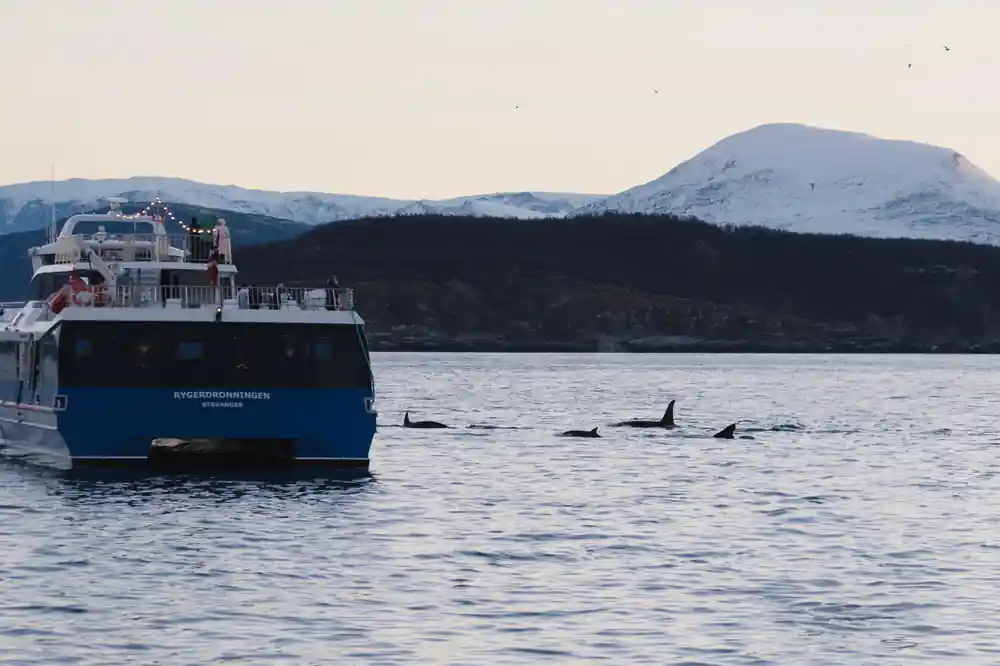
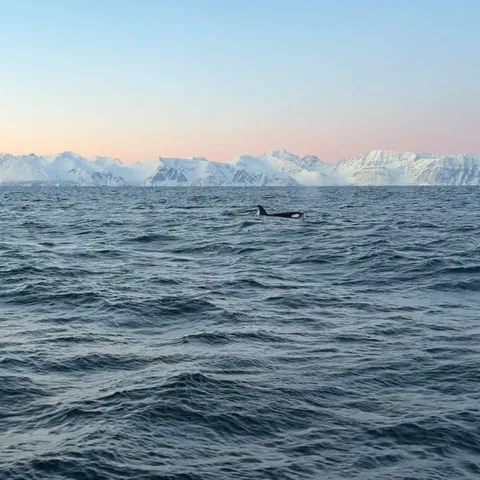
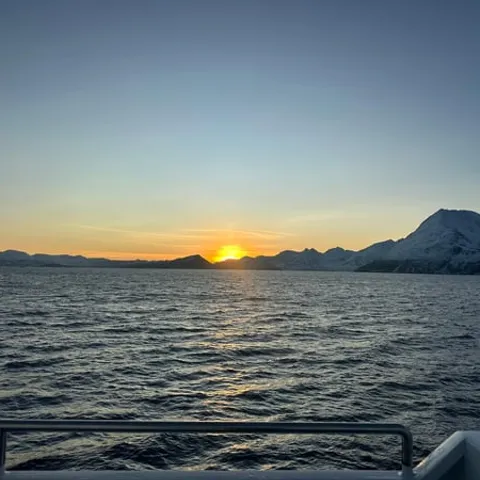
Polar Night Season happens every year in Tromsø . It begins on November 27th and lasts until January 15th.
A long, comfortable winter day on the fjord
Booking and logistics
White-Tailed Sea Eagles Overhead
The white-tailed sea eagle is the bird most people notice first, and it is hard to miss. A full-grown eagle is a heavy, dark-winged shape with a pale head and a broad white tail, and it often sits on a rock or a fence post at the water's edge until the boat is almost level with it. Then it lifts, unhurried, and flaps low across the fjord with slow, deliberate wingbeats. Along the route north towards Skjervøy there are plenty of low skerries, fish farm rafts and cliff ledges where eagles perch, and a quiet catamaran can pass within easy viewing distance without disturbing them.
Binoculars help, but your own eyes will do, because eagles are large and they move against a background of grey rock and dark water. Watch for the white tail as a bird turns away from you; that flash is the giveaway. On Brim Explorer's silent whale watching tour, the crew watch for birds flying overhead where humpback whales push herring to the surface, and use radar and sonar to find obstacles in open water, which is a reminder that birds and whales often work the same patch of sea.[15] Photographers should keep the shutter speed high on a moving deck.
Grey and Harbour Seals on Ice
Seals are the quiet company of a winter whale safari. Grey seals are the big, Roman-nosed ones, mottled and heavy, and harbour seals are smaller and rounder with a gentler face. Both haul out on low rocks, harbour walls, buoys and any shelf of ice that survives the swell, and they often look like part of the rock until one lifts its head or slides into the water. In the fjords around Skjervøy you may pass a dozen or more lying in a row, watching you pass with the mild curiosity of animals that have seen boats before.
The high-speed catamaran safari from Tromsø lists its route as catamaran, Skjervøy, catamaran, so most of the day is spent on the water, moving between fjord arms.[10] Keep your eyes on the shoreline as well as the open water: seals prefer to rest where they can slip straight back into deep water, which usually means a steep rock face or the outer edge of an ice floe. Do not expect them to perform. A seal that is simply watching you is behaving exactly as it should.
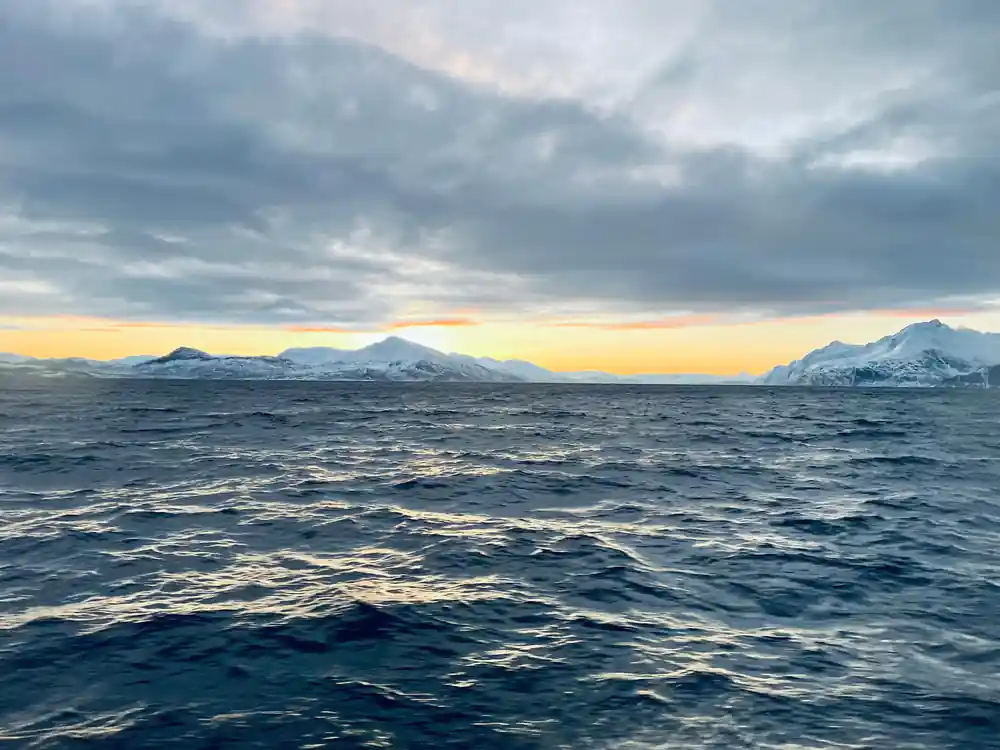
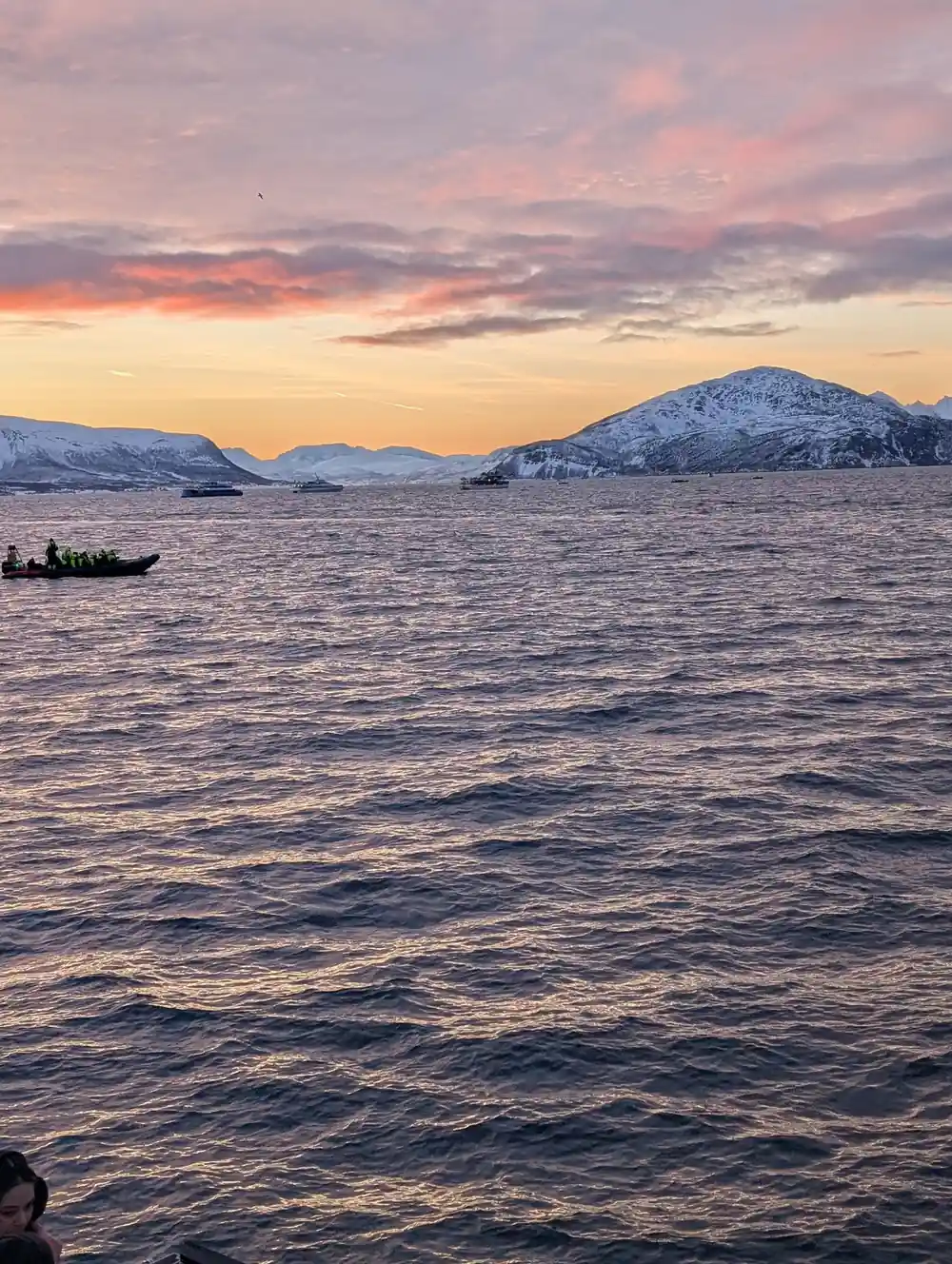
A catamaran among snow-covered peaks on the run north towards Skjervøy.
Harbour Porpoises and Dolphins in Winter
Harbour porpoises are the smallest cetaceans you are likely to see, and they are also the hardest to catch. They surface briefly with a small, dark, triangular fin and a soft puff of breath, then vanish. There is no bow-riding, no breaching, no show. In winter, when the herring are in and the big whales are feeding, porpoises sometimes turn up in the same water, quietly working the edges of the action. In summer, minke whales and porpoises are occasionally spotted in Tromsø, although sightings are fewer than in the winter season.[16]
White-beaked dolphins are the dolphins most often seen in these northern fjords, usually in loose groups that move quickly and break the surface in short bursts. If you see several fins at once, look for the pale flank and the blunt, pale beak. The winter season is the herring season: orcas and humpbacks follow the herring into the Tromsø and Skjervøy fjords roughly from November through January.[9] Nothing is guaranteed on a wildlife day, so treat every fin as a bonus.
Seabirds Following the Winter Herring
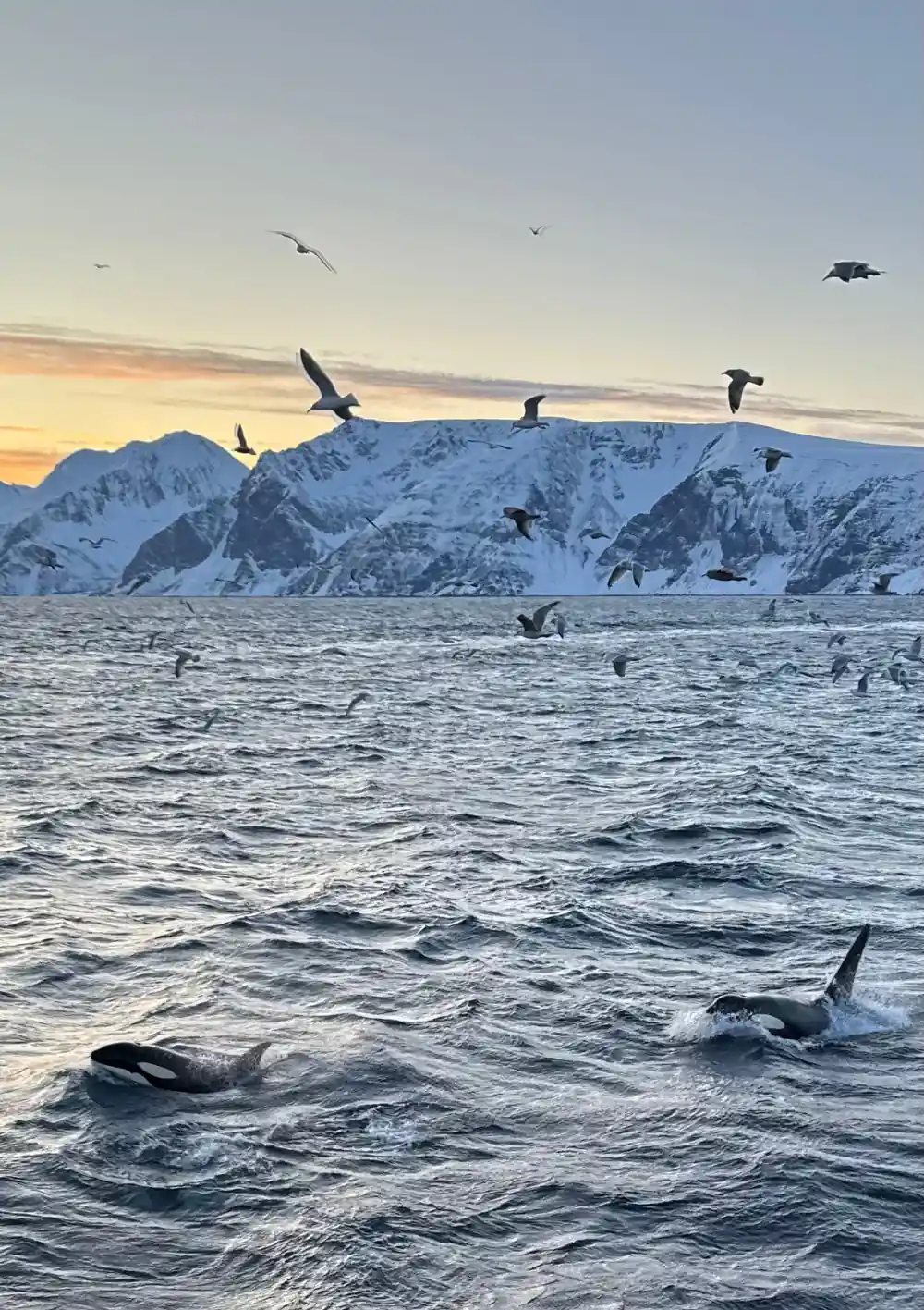
Where there is herring, there are birds. Gulls, cormorants, guillemots, razorbills and kittiwakes all work the shoals, and a tight, noisy flock over open water is one of the best clues that something larger is hunting underneath. The migration of Norwegian spring-spawning herring draws killer whales into northern Norwegian waters each winter, and the birds follow the same fish.[17] Point a feeding flock out to the crew; they will know what it usually means.
Birds also teach patience. Herring shoals move, sometimes several miles between one day and the next, and the whales move with them. Crews use every tool they have: on Brim Explorer's silent whale watching tour, the crew watch for birds flying overhead where humpback whales push herring to the surface, and use radar and sonar to find obstacles in open water.[15] That mix of careful watching and electronics is what a whale safari really is. Keep binoculars round your neck and share what you spot.
8 hours
The From Tromsø: Whale Watching Safari on High-Speed Catamaran is listed at 8 hours, is wheelchair accessible and offers free rebooking.[10]
Reindeer and Shoreline Mammals
Whales are the headline, but the drive is a safari too. If your tour transfers by coach or minibus towards Skjervøy, you cross farmland, birch scrub and open fell, and semi-domesticated reindeer graze on the hillsides through the winter. They are stockier than you might expect, and a herd often stands in the road as if it owns it, which it more or less does. Otters work the harbour edges, and mink and the occasional moose turn up along the water.
Longer RIB and coach days are the ones that give you time to look. A Skjervøy RIB whale watching tour with coach transfers is listed at 12 hours, with Bus/coach, Skjervoy, Bus/coach as its route.[18] Another RIB safari at Skjervøy is listed at 3 - 12 hours.[12] On any of them, the transfer is not dead time: keep watching the verges and the shoreline. Reindeer, hares, foxes and sea eagles all appear between the fjord and the road, and the low winter light on snow does the rest.
Why Winter Concentrates Arctic Wildlife
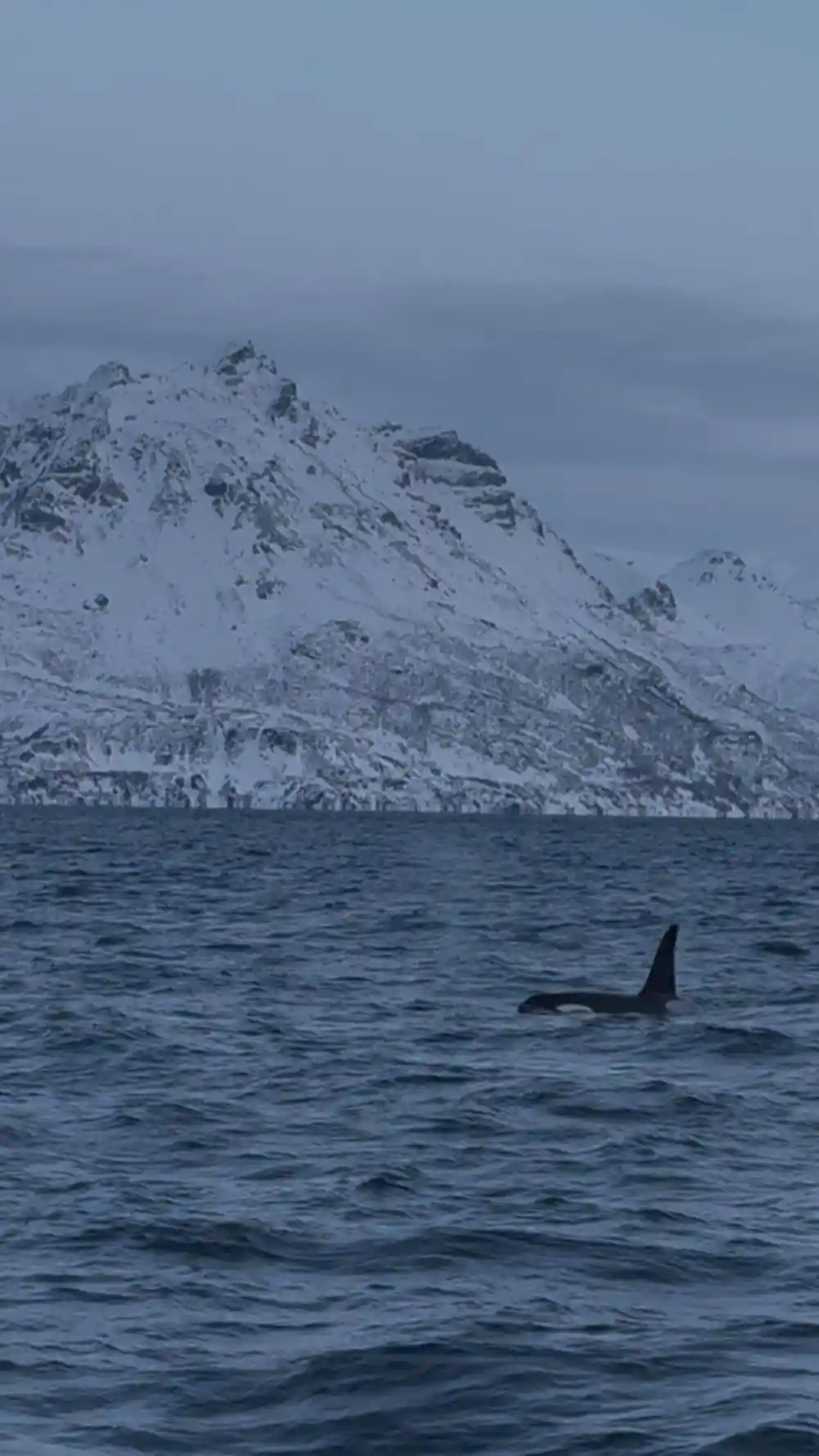
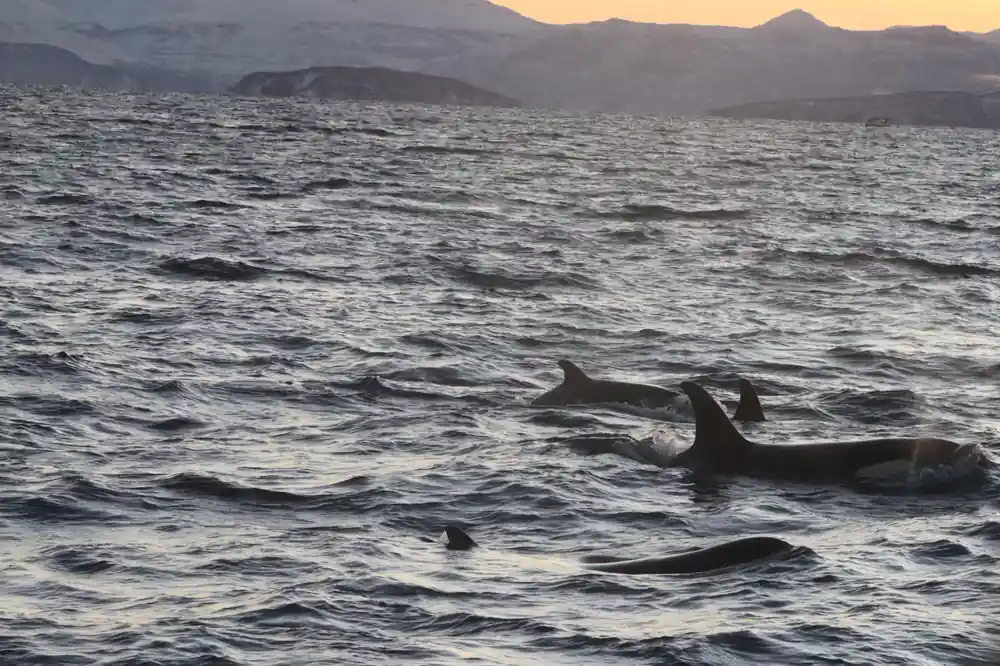
Winter is when the north coast becomes a feeding ground. In Tromsø the whale season runs roughly from November through January, when orcas and humpbacks follow herring into the Tromsø and Skjervøy fjords.[9] The whole system is built on one small silver fish. The migration of Norwegian spring-spawning herring draws killer whales into northern Norwegian waters each winter.[17] Where the shoals bunch up, whales, dolphins, seals and seabirds all converge on the same water.
The gathering point has shifted. Since around 2017, whales near Tromsø have usually gathered in the Kvænangen fjords near Skjervøy rather than the waters closer to Tromsø, and the 2025-2026 season followed the same pattern.[9] Whale tours from the city handle this in different ways: a fast catamaran sails north, while other trips drive the coast road and put you on a boat at Skjervøy. The season also overlaps the darkest weeks: in Tromsø the Polar Night Season begins on November 27th and lasts until January 15th.[19] Expect low light, blue hours and average winter temperatures of around -4°C.[11]
The Dark Sail Home and Possible Aurora
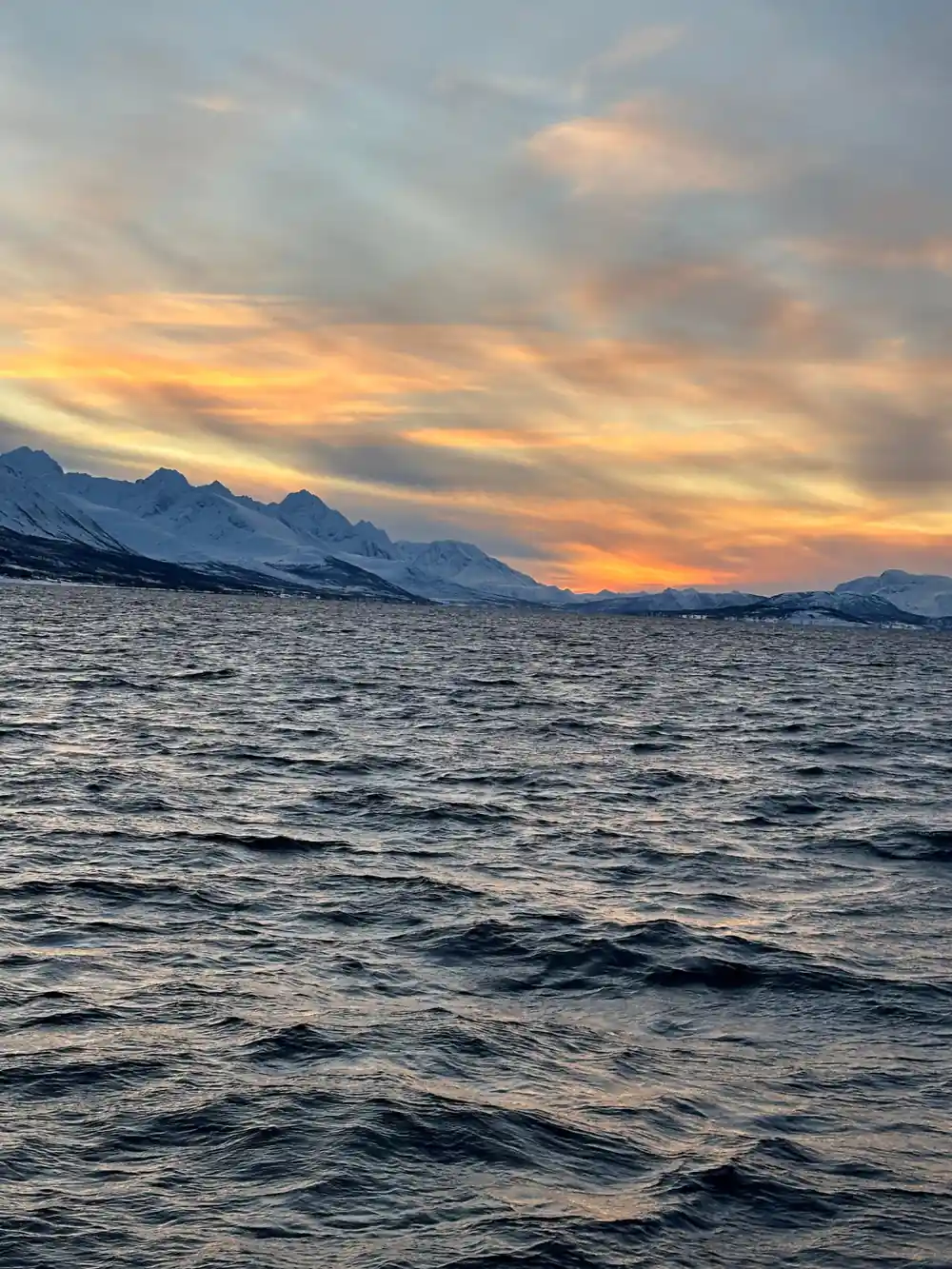
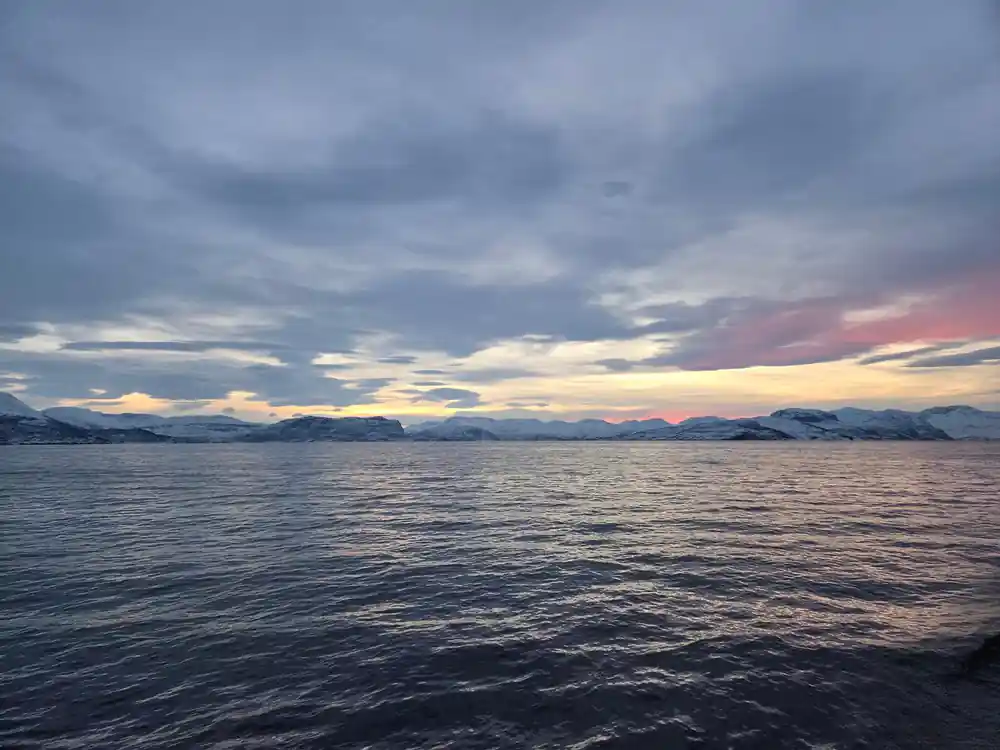
The return leg is often the quiet part of the day. The light goes early at the darkest point of the winter, the deck lights come on, and the fjord turns to black glass with the boat's wake behind it. If the sky clears and aurora activity picks up, green arcs can appear over the hills, sometimes faint, sometimes filling the whole sky. Nothing about it can be booked or promised; it is weather, cloud and solar wind, and it either happens or it does not.
This is where a whale day and a northern lights night can meet. The high-speed catamaran safari from Tromsø is listed at 8 hours, and the listing says to check availability to see starting times.[10] Many travellers pair it with a Tromso cruise northern lights evening on another night of their stay, since cloud and aurora forecasts change from day to day. Treat any aurora on the sail home as a gift rather than a plan.
Listed tour durations for Tromsø whale trips
Durations as listed on GetYourGuide, in hours: 7.5[13], 8[10], 8[20] and 9[21].
From-prices on Tromsø whale tours
From-prices in US dollars taken from the GetYourGuide listings: US$220[10], US$210[13], US$251[12], US$215[20] and US$209[21]. These are the per-person adult from-prices shown on those listings.
When to book a whale watching day
Plan your whale day
Pick the boat
Catamaran trips give you a cabin and steadier decks; RIB trips are faster, with flotation suits provided on RIB whale watching tours.[22]
Dress for a cold deck
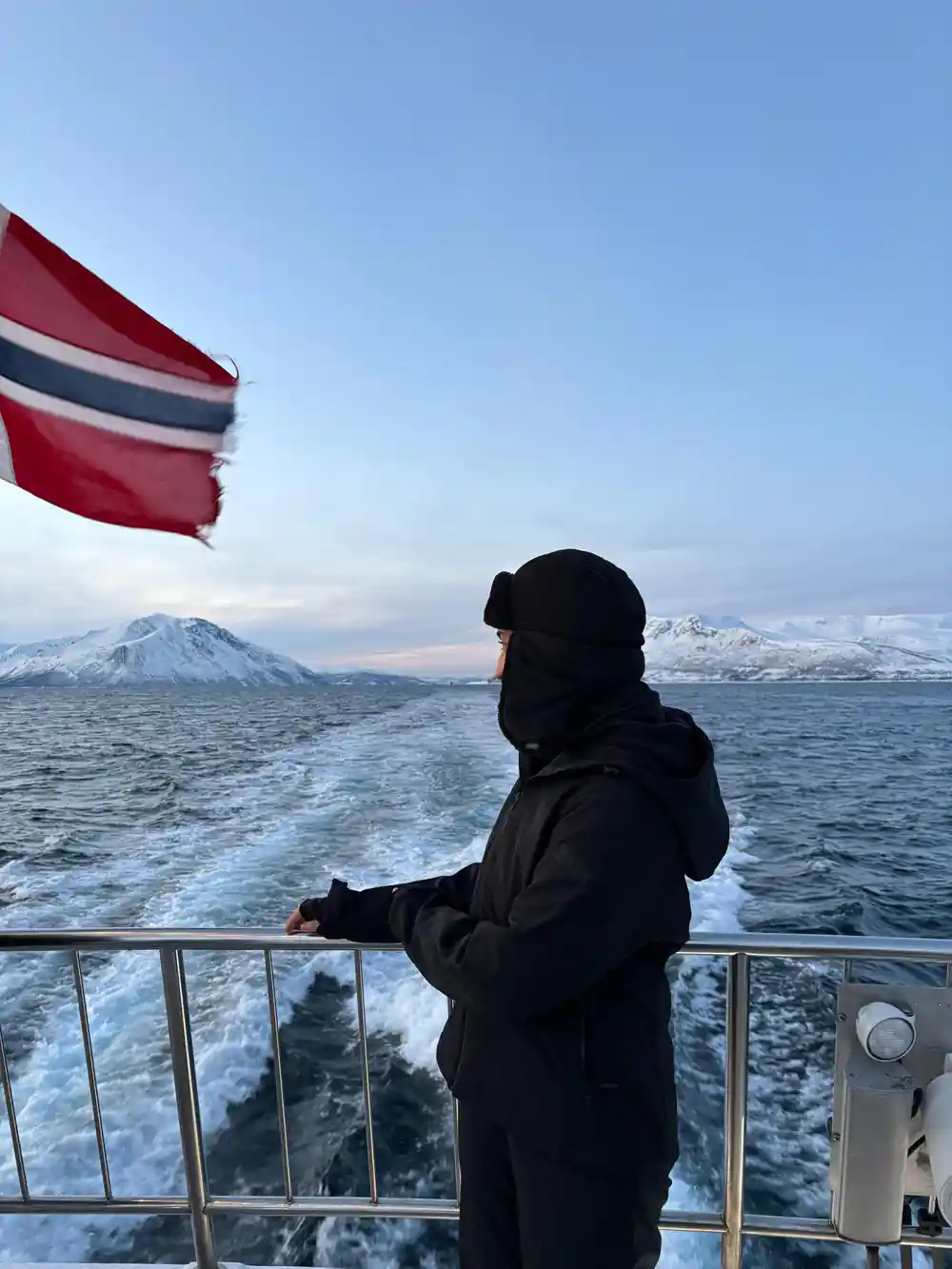
The average winter temperature in Tromsø is around -4°C, so use wool layers, a windproof shell, hat, gloves and shoes with grip.[11]
Check the timings
The high-speed catamaran safari is listed at 8 hours, and the listing says to check availability to see starting times.[10]
Watch the water
Birds working over a patch of sea are a good sign, and on Brim Explorer's silent tour the crew watch for birds where humpback whales push herring up.[15]
Keep the evening free
Winter returns happen in the dark, so leave the evening open in case the sky clears for aurora on the way back.
Step aboard the high-speed catamaran whale safari
from US$220Reserve now & pay later