The essentials
- The safari booked from this site runs 8 hours from Tromsø to Skjervøy and back by high-speed catamaran, from US$220.[1]
- The season runs roughly November through January, when orcas and humpbacks follow herring into the Tromsø and Skjervøy fjords.[2]
- Polar Night Season in Tromsø begins on November 27th and lasts until January 15th, and the average winter temperature is around −4°C.[3][4]
- Since around 2017 the whales have usually gathered in the Kvænangen fjords near Skjervøy rather than closer to Tromsø.[2]
- Reserve now and pay later, and free cancellation up to 24 hours in advance for a full refund on the catamaran safari.[1]
- Top choice High-speed catamaran from US$220 Duration8 hours[1]Rated4.61 from 3,768 reviews[1]GuideLive tour guide: English[1]CancellationFree cancellation, 24 hours ahead[1]BookingReserve now & pay later[1] Check availability
- RIB safari at Skjervøy from US$251 Duration3 - 12 hours[5]Rated4.78 from 136 reviews[5]GuideLive tour guide: English[5]CancellationFree cancellation, 24 hours ahead[5]BookingReserve now & pay later[5] See this tour
- Fast catamaran from US$210 Duration7.5 hours[6]Rated4.71 from 661 reviews[6]GuideLive tour guide: English[6]CancellationFree cancellation, 24 hours ahead[6]BookingReserve now & pay later[6] See this tour
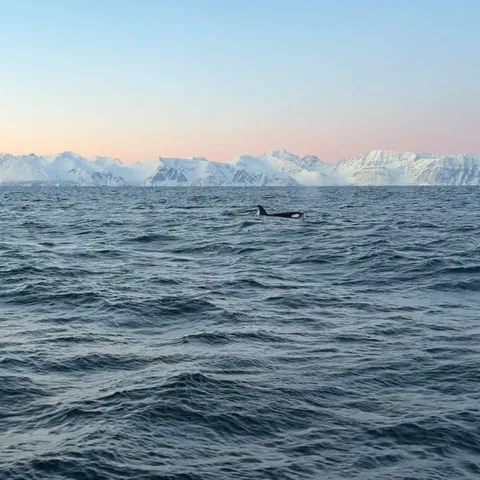
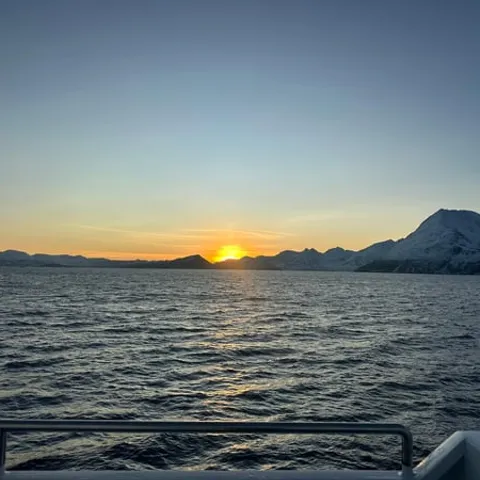
Its also common to find a lot of birds flying overhead where whales are, as they like to eat the herring that is pushed to the surface by the humpback whales.
Worth it for photographers who plan for low light
On the water
- Camera set up before boarding, so there are no menu dives on deck
- Clear filter and rain cover against salt spray
- Spare cards and batteries in an inside pocket
- Dry cloths for the front element, another for the body
Ahead of the trip
- Match your dates to the winter whale season, not the summer
- Expect a transfer out to the whale grounds and back
- Layers, hat and gloves with fingertips you can open
- Choose a small group boat if you want elbow room at the rail
Choosing Your Lens for Open-Deck Whale Photography
On a whale safari you shoot from a moving deck at animals that surface without warning, so the simple answer is a single camera and a single zoom. A medium telephoto zoom covers most of it: a dorsal fin cutting the water at mid distance, a tail fluke lifting as the whale sounds, a humpback's back rolling through a swell. Take a wide lens or a phone as well, because the boat, the fjord walls and the mountains keep happening whether you planned them or not.
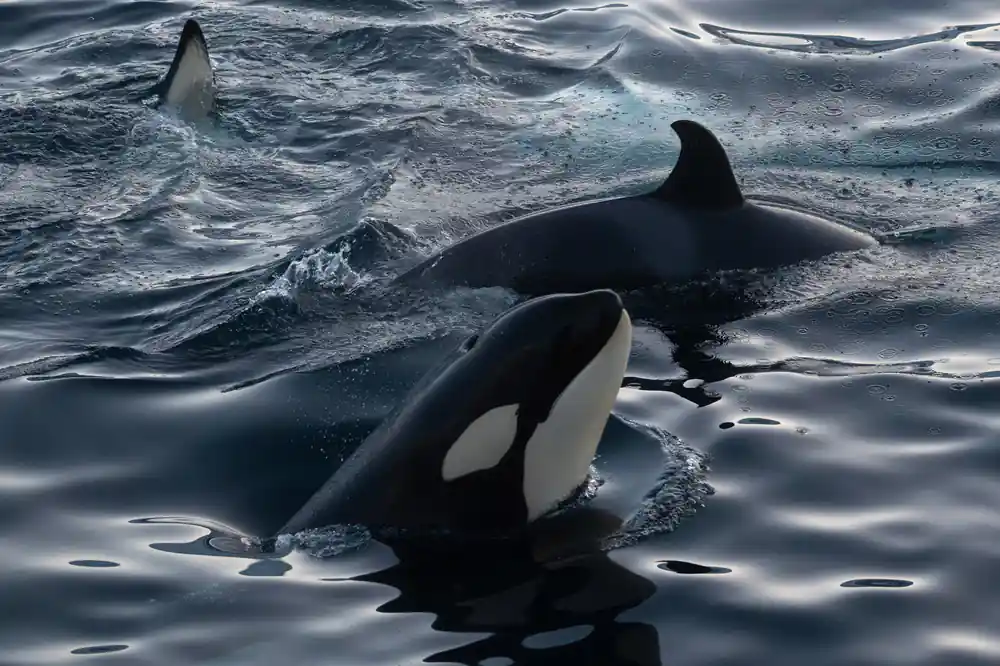
The whales you are most likely to meet are orcas and humpbacks, and the season runs roughly from November through January, when they follow herring into the Tromsø and Skjervøy fjords.[2] Since around 2017 that has usually meant the Kvænangen fjords near Skjervøy rather than the waters closer to Tromsø, and the 2025-2026 season followed the same pattern.[2] The day is built around the crossing as much as around the whale stop, so pack as if you will be outside for all of it.
Zoom range matters more than lens speed here. A slower long zoom beats a fast prime you cannot point in time, and winter light will push you to high ISO whatever glass you carry. Keep the polarising filter for the wide shots and leave it off the long lens, where it costs light you do not have.
Exposure and Autofocus in Polar Twilight
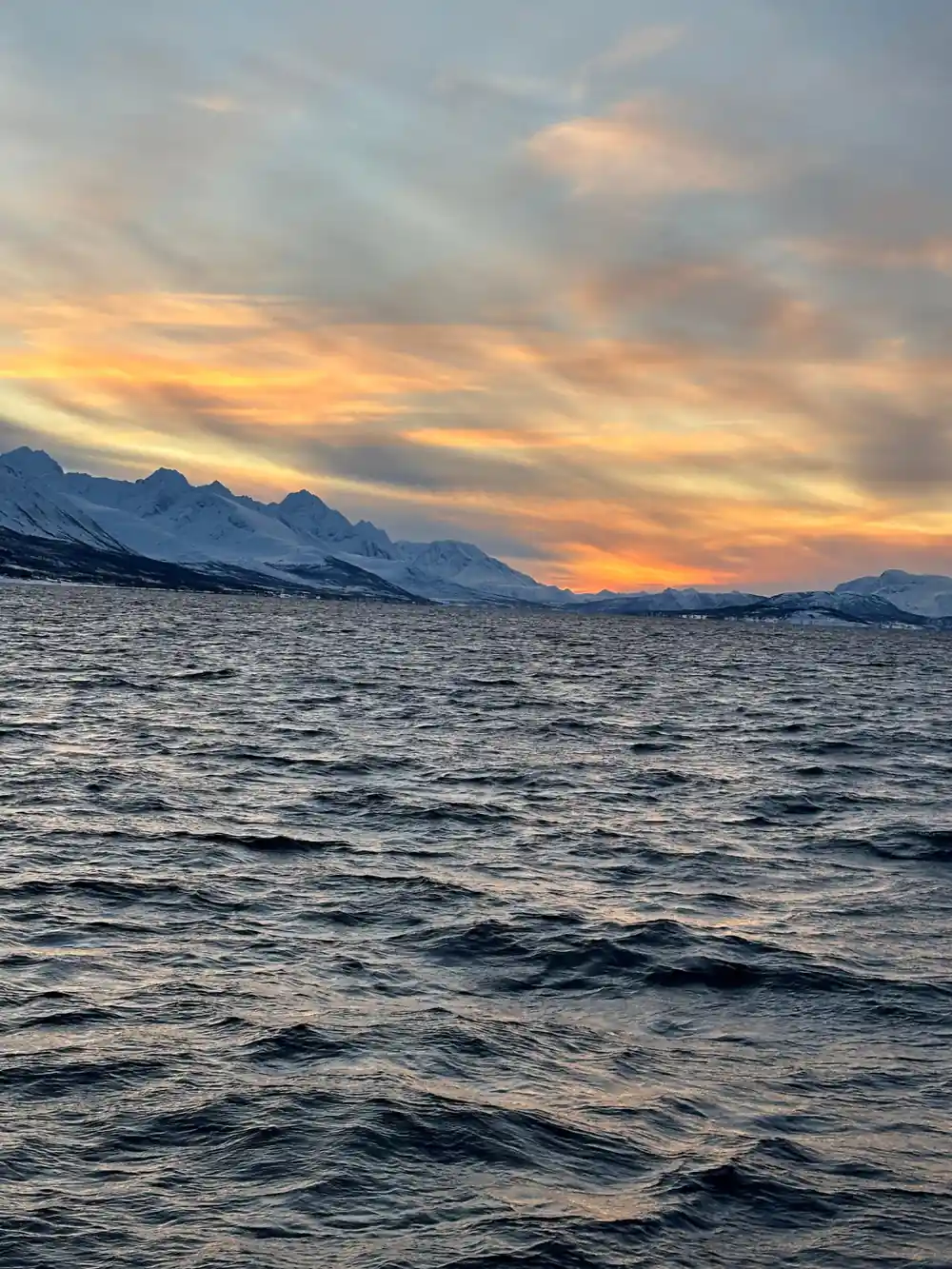
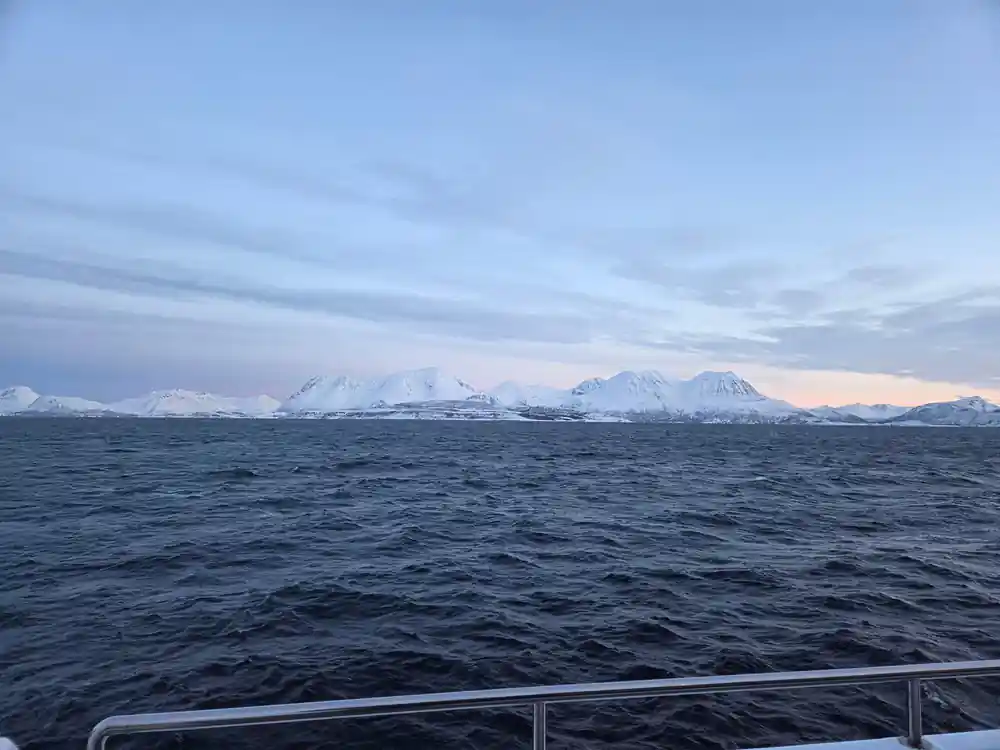
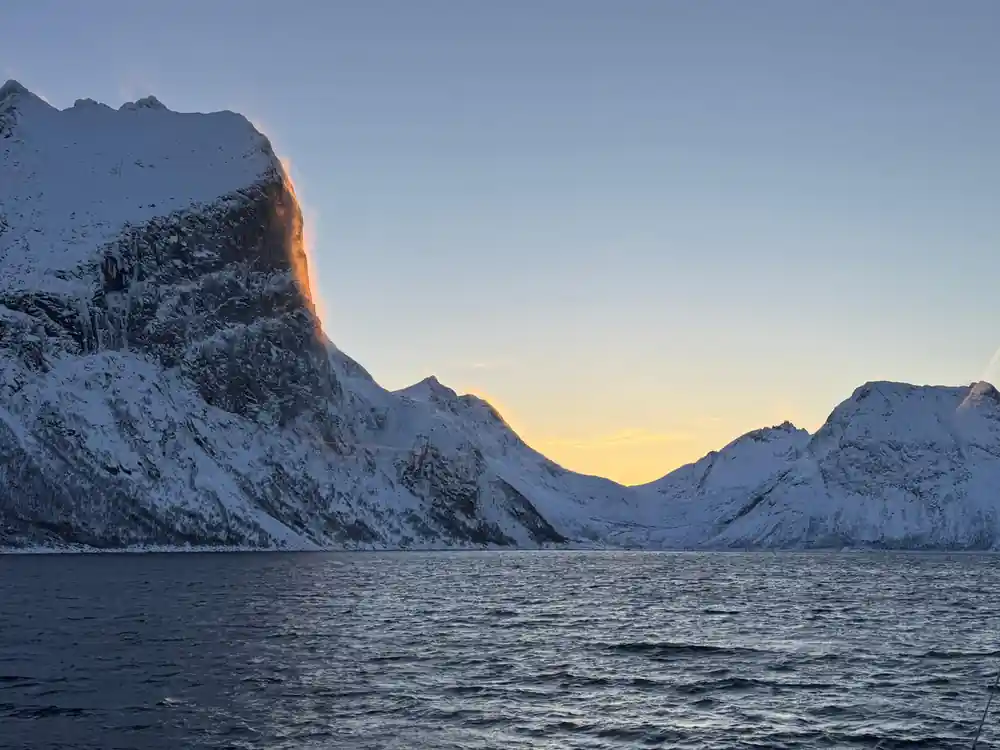
Winter light in Tromsø is low, soft and blue for most of the day, and around midwinter the daylight is a long dusk that never quite arrives. Polar Night Season begins on November 27th and lasts until January 15th.[3] Your meter will ask for slow shutters and high ISO, and a breaching whale will not wait while you adjust. Set the camera up at the quay, while your hands are still warm, before the boat leaves.
Start in shutter priority with the fastest shutter the light allows, and let the camera raise the ISO. Grain is better than blur, so do not chase a low number. Use continuous autofocus with a wide zone or a group of points rather than a single point, and switch to burst mode so the frame after the blow is already in the buffer. Expose for the water: a dark whale against bright water reads clearly, while a brightened whale against grey water turns to mush.
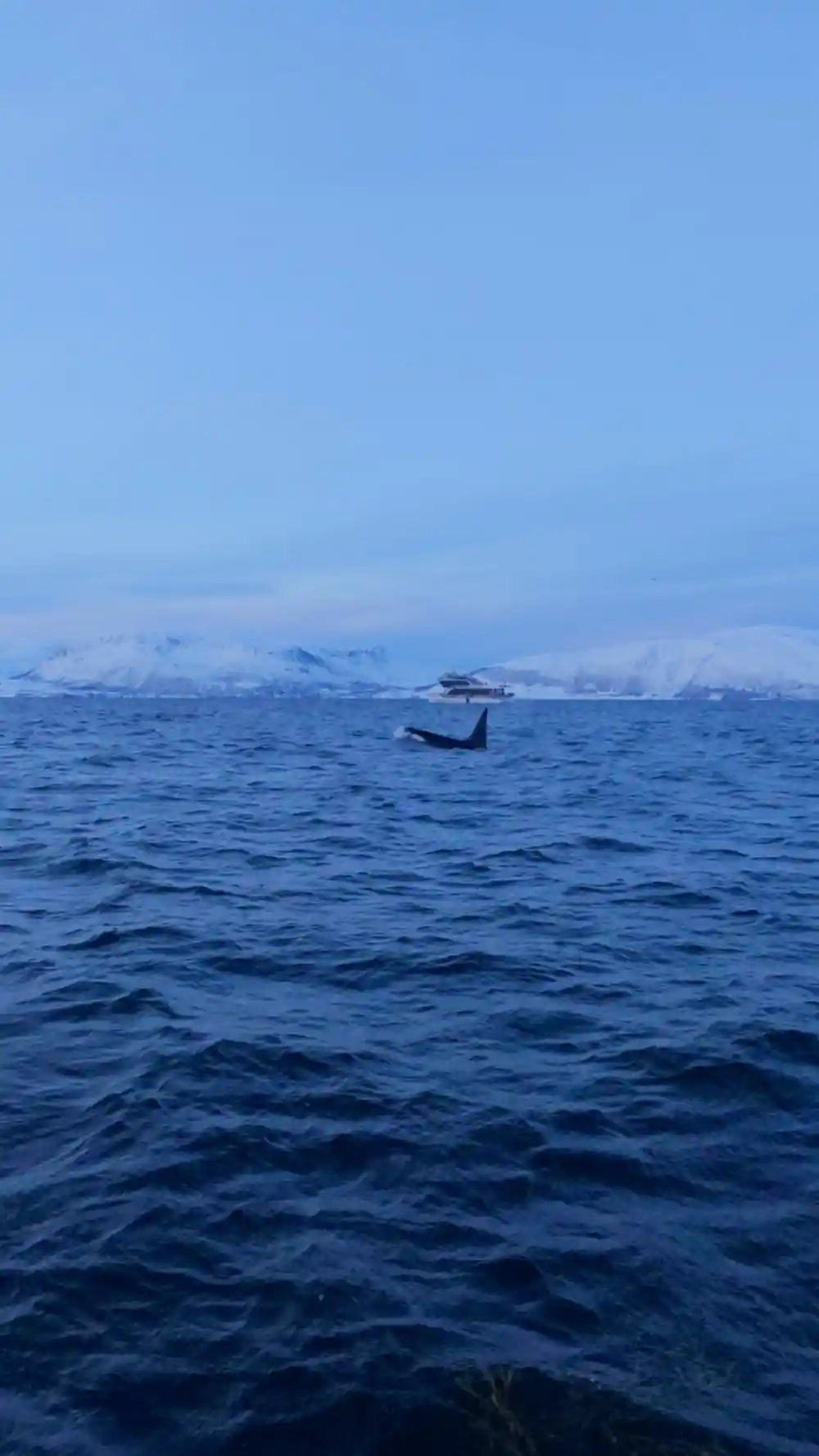
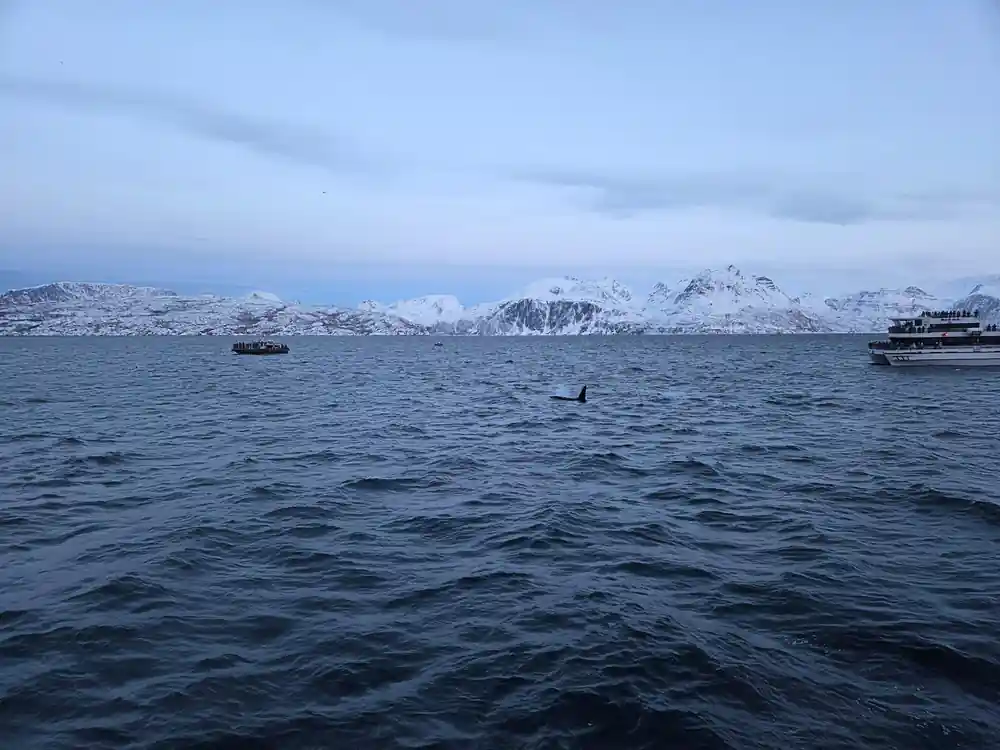
Finding the animals is half the work, and the crew's eyes matter more than any setting. It is common to find a lot of birds flying overhead where whales are, as they feed on herring pushed to the surface by humpback whales, and crews also use radar and sonar to find obstacles in open water.[7] Watch where the guide points, and be ready before the boat slows.
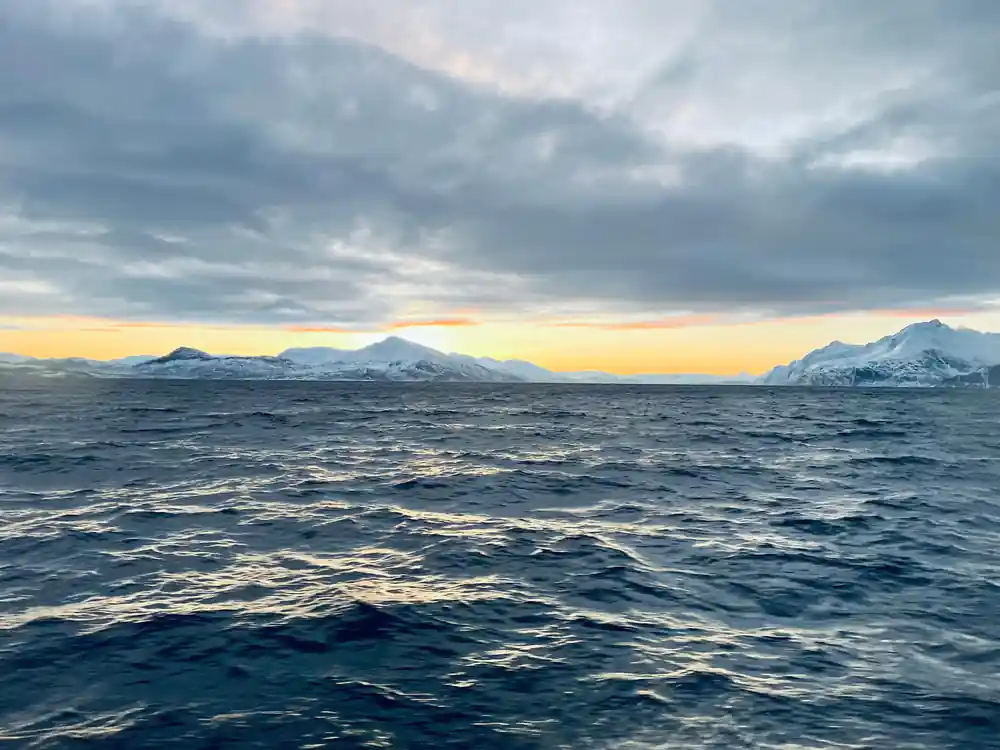
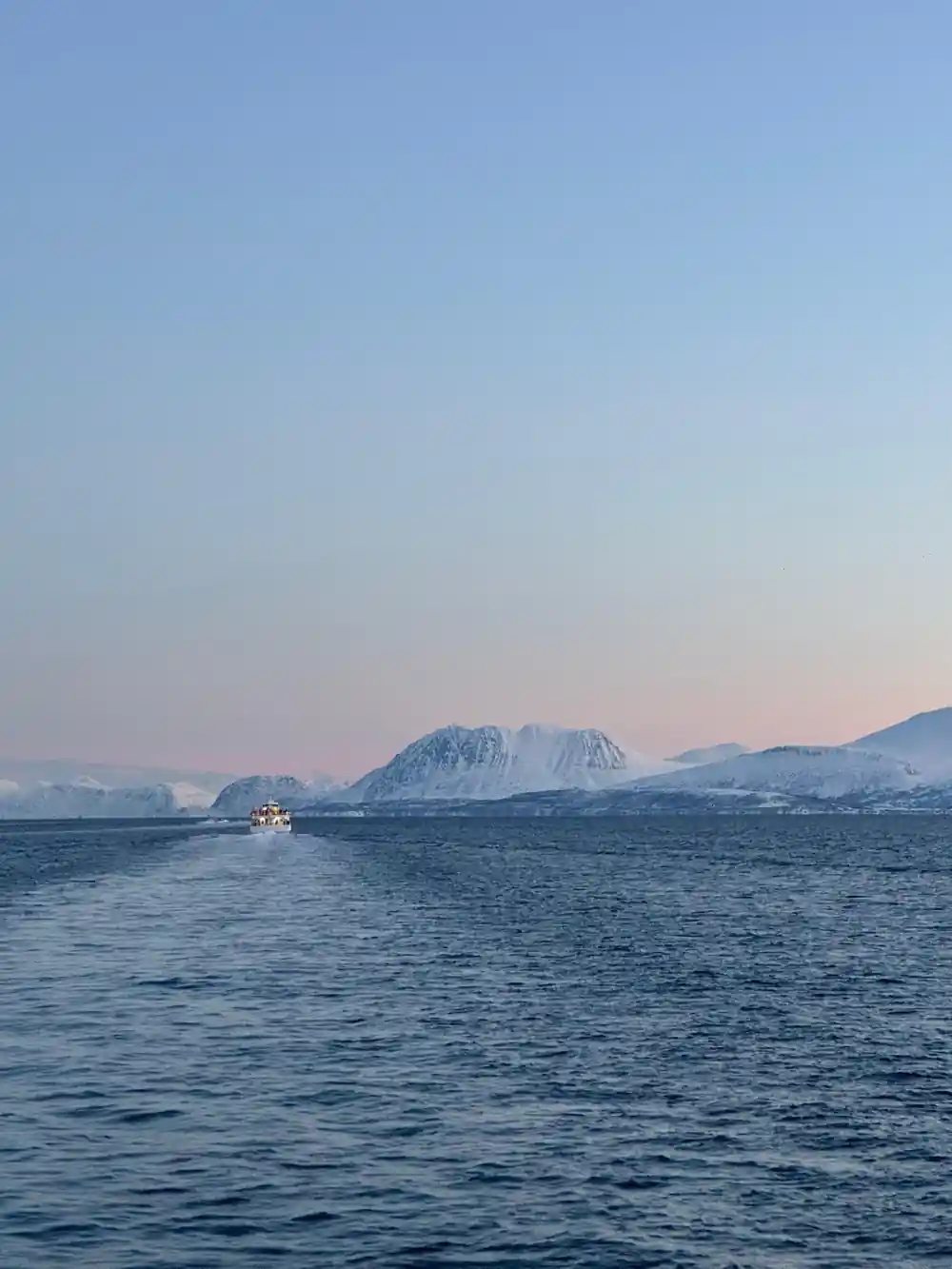
A catamaran deck in blue winter light, with the fjord quiet around the boat.
Positioning Yourself on the Catamaran Deck
The safari booked from this site runs 8 hours, and its stops are listed as Catamaran, Skjervøy and Catamaran.[1] You spend that time on a stable deck rather than in a small open boat, which suits a long lens and a photographer who would rather not brace against every wave. Find a spot along the rail where you can move a few steps without pushing past people.
Whale watching in Tromsø follows guidelines that ask boats to approach slowly, at less than 5 knots when within 300m, at constant speed, from the side and slightly to the rear.[8] That usually gives you a broadside view of an animal travelling, so keep some space behind you instead of hugging the bow. Other Tromsø boats work differently: Rødne Fjord Cruise runs a 7-8 hour round trip with no disembarkation,[9] and Brim Explorer's Silent Whale Watching uses a hybrid-electric ship that can operate silently in electric mode.[7]
What decides whether your position works is the horizon and the direction of the light. Stand where the brightest part of the sky is behind you rather than in front of the lens, and check that the rail is not cutting through every frame at eye level. With a long lens, sit or crouch at the rail, and keep your bag between your feet so it does not slide when the boat turns.
Managing Batteries and Condensation in Arctic Cold
Cold is the quiet enemy of a whale photography day. Battery capacity falls away in the frost, so carry spares in an inside pocket, close to your body, and swap them early rather than waiting for the warning. The average winter temperature in Tromsø is around −4°C, and it can vary considerably, particularly if you travel inland.[4] The deck wind is what really bites.
Condensation is the other problem. A camera that has been on a cold deck for hours fogs instantly when it comes into a warm cabin, and moisture inside a lens is a repair, not a wipe. Put the body into a sealed bag before you step inside and let it warm slowly, with the bag closed until the glass reaches cabin temperature. Breathing on a cold viewfinder, or on the front element, has the same effect.
A small silica sachet in the bag, batteries charged the night before, and a spare card in a zipped pocket are cheap insurance. Gloves that let you feel the dials, or thin liners under mittens, decide whether you are shooting or fumbling when the call comes over the deck.
from US$220
The high-speed catamaran safari runs 8 hours from Tromsø to Skjervøy and back, with a live English-speaking guide.[1]
Protecting Gear from Salt Spray
Salt spray is harder on gear than rain. It dries to a fine crust that scatters light on the front element and creeps into switches, so keep a clear filter on every lens and treat it as sacrificial. A rain cover, or even a shower cap, protects the body and dials, and a dry microfibre cloth for the glass plus another for the housing gets you back to sharp frames in seconds.
Never change lenses on the open deck. If you must swap, go inside, out of the wind, with the camera shielded and the new lens uncapped and ready. Zooms that pump air in and out deserve a wipe around the barrel after every session, and the tripod, the bag and your jacket all want a fresh-water rinse once you are back ashore.
If you prefer a lower angle at the water, RIB whale watching tours provide full-length flotation suits, often called drysuits or immersion suits, to wear over your own clothing.[10] That is a different platform: faster, wetter and closer to the surface, so a waterproof pouch or a dry bag for the camera is worth carrying on those trips.
What Phone Cameras Can and Cannot Deliver
A phone is a genuinely useful second camera on a whale safari. It handles the wide shots beautifully: the catamaran from the quay, the fjord walls, the low light on the water, the boat full of people in orange life jackets. It will also capture a blow and a distant fin as a record of the day, and that is often all a traveller wants from a first whale trip.
What it cannot do is reach. Digital zoom crops and smears, so a fluke photographed at distance on a phone is a small pale shape. If whales are the point of the trip, use the main lens, accept the wide framing and let a long-lens camera take the close work. On the phone, tap to focus on the water where the whale went down, lock exposure so the bright sea does not darken your subject, and shoot in bursts.
Keep the phone warm in an inside pocket, because cold batteries behave exactly as camera batteries do, and consider a waterproof pouch for spray. Wipe the lens before every shot; a fingerprint on a phone lens is softer than any mistake you can make with a big camera.
Aurora Shooting on the Return and Realistic Expectations
The run back to Tromsø can be the part of the day photographers remember. The deck is dark, the fjord is black, and on a clear night there is a chance of aurora over the water. If you are wondering how to photograph northern lights on an iPhone, the short version is night mode, the phone braced against something solid, the longest exposure it will allow, and no flash. A wide camera on a small tripod, or resting on the rail, will do better still.
Set expectations for the whales first. Sightings are never guaranteed, whatever the boat and whatever the season. The migration of Norwegian spring-spawning herring draws killer whales into northern Norwegian waters each winter,[11] and in summer minke whales and porpoises are occasionally spotted, although sightings are fewer than in the winter season.[12] A safari that finds nothing is still a dark, beautiful day on the water, but if your trip is built around whales, go in the winter weeks.
Book with a clear head about the terms. The high-speed catamaran safari listed from US$220 offers reserve now and pay later, free rebooking, and free cancellation up to 24 hours in advance for a full refund.[1] It runs 8 hours with a live English-speaking guide.[1] For a photographer, a long and stable day on the water is the main thing, and that is what this trip is.
From-price by whale tour from Tromsø
From-prices are GetYourGuide listing figures in US dollars:[1][5][6][13][14][15].
Adult from-prices for Tromsø whale tours
Adult from-prices in US dollars from these GetYourGuide listings:[1][5][6][13]. Child from-prices are not listed.
When to book a whale photography trip
Deck shooting workflow
Check the light before you board
Look at the sky from the quay, set white balance and exposure, and decide your starting shutter speed while your hands are still warm.
Set autofocus before the first blow
Continuous autofocus, a wide zone and burst mode mean you catch the surfacing rather than the splash that follows it.
Keep the horizon level
A catamaran is steady, but a tilted sea reads as a mistake. Watch the horizon line in the viewfinder when whales come close.
Wipe the front element often
Spray dries to salt, and salt turns every frame soft. A dry microfibre cloth in a zipped pocket solves it in seconds.
Stop shooting to watch
Lower the camera for one surfacing, then raise it again. You will remember the whale, and you will still get the shot.
Photograph orcas and humpbacks from a high-speed catamaran
from US$220Reserve now & pay later